2025's Biggest Gaming Trend: AI NPCs Are Changing Games Forever
- Turker Senturk
- Gaming , AI , Technology
- 17 Nov, 2025
- 11 min read
The gaming industry is experiencing a seismic shift in 2025, and it’s not about graphics or hardware—it’s about intelligence. After decades of repetitive dialogue and predictable behaviors, non-playable characters (NPCs) are finally getting the upgrade they deserve. Thanks to groundbreaking advancements in generative AI, NPCs are evolving from scripted robots into dynamic, intelligent beings capable of genuine conversations, emotional responses, and autonomous decision-making.
This isn’t just another tech demo. Major games launching in 2025 are already implementing AI-powered NPCs that remember your actions, adapt to your playstyle, and create unique experiences for every player. The era of lifeless shopkeepers repeating the same three lines is officially over.
The Technology Behind Intelligent NPCs
Two major platforms are leading the AI NPC revolution: NVIDIA’s Avatar Cloud Engine (ACE) and Inworld AI. Both use small language models (SLMs) and advanced AI frameworks to power real-time character interactions, but they approach the challenge differently.
NVIDIA ACE: Autonomous Game Characters
NVIDIA ACE is a suite of RTX-accelerated digital human technologies that bring game characters to life with generative AI, expanding from conversational NPCs to autonomous game characters that use AI to perceive, plan, and act like human players.
The technology works through three core capabilities:
Perception: AI characters can understand their environment, recognize objects, and respond to dynamic game events in real-time. They don’t just follow pre-programmed patrol routes—they actually observe what’s happening around them.
Cognition: Using on-device small language models, these NPCs can process information, make strategic decisions, and form coherent responses based on game context and player behavior.
Action: AI characters can autonomously execute complex tasks like collecting loot, engaging enemies, providing tactical advice, and adapting their strategies without additional player input.
NVIDIA’s Nemotron-4 4B Instruct is the company’s first digital human technology on-device small language model, designed for role-playing with leading retrieval-augmented generation and function-calling capabilities.
Inworld AI: Character Engine Platform
Inworld AI takes a different approach by providing developers with a comprehensive platform for building AI-driven characters with memory, motivations, and emotional models. At GDC 2025, Inworld showcased real games using AI at scale, enjoyed by millions of players, demonstrating how developers have overcome structural barriers to ship AI-powered games.
The platform achieved remarkable performance improvements: Inworld achieved 200ms response times compared to standard cloud APIs that had 1-2 second delays, making AI assistants feel present in the moment.
Games Leading the AI NPC Revolution
Several high-profile titles are launching with AI NPCs in 2025, demonstrating the practical applications of this technology:
PUBG: BATTLEGROUNDS - PUBG Ally
PUBG: BATTLEGROUNDS, one of the top five most played games on Steam, is introducing Co-Playable Character (CPC) with PUBG Ally, featuring NVIDIA ACE-powered teammates that help players battle enemies, hunt for loot, and fight for victory. Testing begins in early 2026 through PUBG Arcade, starting with English, Korean, and Chinese players to collect feedback.
inZOI - Smart Zoi System
KRAFTON’s inZOI is one of the top 5 most wishlisted games on Steam, and players can transform the city’s NPCs into ACE autonomous game characters by activating the “Smart Zoi” experimental feature setting.
Smart Zois with considerate personalities might decide to assist lost characters with directions or offer food to hungry strangers, adjusting their personal schedule of activities based on daily experiences. The game launched on March 28, 2025 with NVIDIA ACE-based characters.
NARAKA: BLADEPOINT MOBILE PC VERSION
In NARAKA: BLADEPOINT MOBILE PC VERSION, on-device NVIDIA ACE-powered teammates help players battle enemies, hunt for loot and fight for victory, launching on March 27, 2025.
Mecha BREAK
Mecha BREAK showcases the first digital human technology on-device small language model, with Amazing Seasun Games implementing NVIDIA Nemotron-4 4B Instruct NIM for ACE-powered game interactions. Players can interact via natural language with their mechanic, asking for advice on objectives and ideal mechs for tasks.
Status by Wishroll
Wishroll’s Status, which ranked as high as #4 in the App Store Lifestyle category, surpassed one million users just two weeks after their public beta launch in February 2025, with players spending an average of an hour and a half per day. The game features AI-powered characters in a social media simulation where players roleplay as celebrities building followers and relationships.
Dead Meat by Meaning Machine
Dead Meat is an upcoming murder mystery game that sees players posing questions to a large language model-powered suspect in an attempt to extract a murder confession. At CES 2025, Dead Meat was shown running in real-time on a GeForce RTX 50 Series GPU, generating dialogue locally for the very first time.
Key Features Transforming Gameplay
The implementation of AI NPCs introduces several game-changing features that were previously impossible:
Long-Term Memory Systems
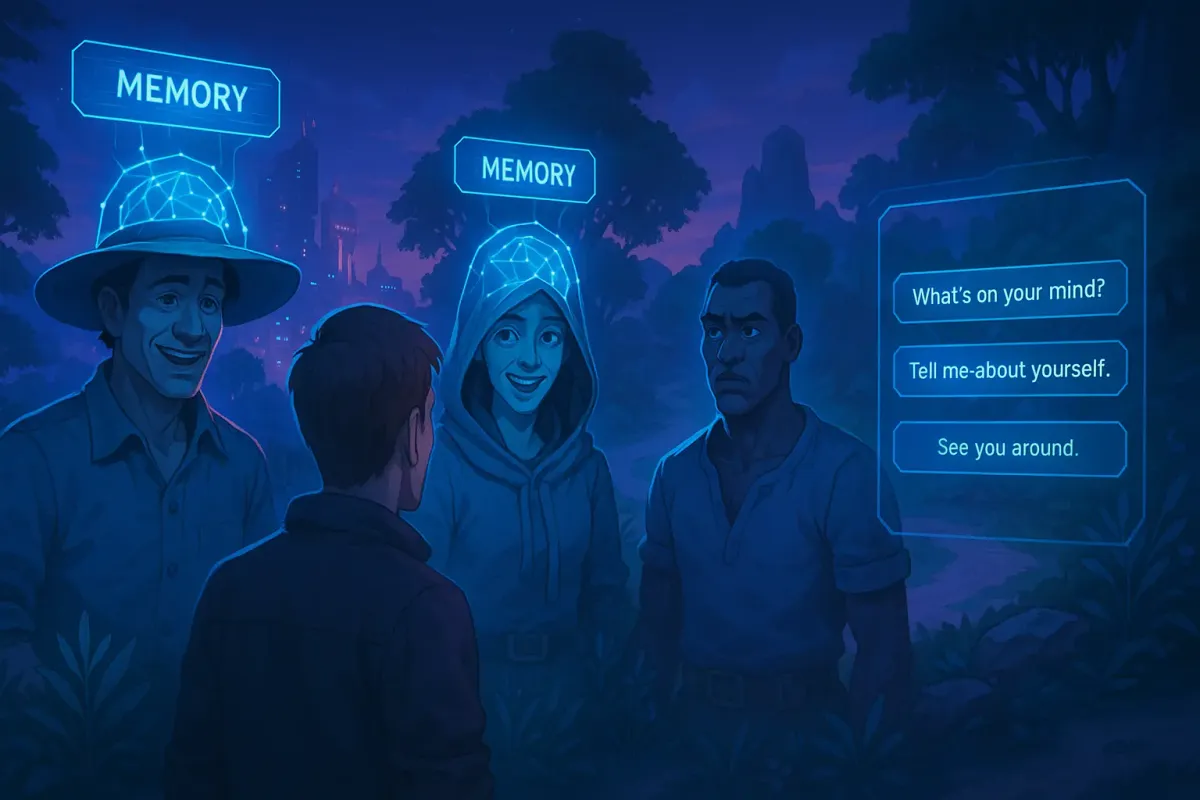
AI NPCs can remember past interactions, influence future plotlines, and form relationships with players based on their actions throughout the game. An NPC shopkeeper might recall that you helped them three quests ago and offer you a discount, or an enemy faction could remember your aggressive tactics and adjust their defenses accordingly.
Dynamic Conversations
Gone are the rigid dialogue trees. AI NPCs use natural language processing, machine learning, and large language models like OpenAI’s GPT, Google’s Gemini, or NVIDIA’s ACE platform to create more natural, context-aware dialogue and decision-making.
Emotional Intelligence
NPCs can simulate a range of emotions and make decisions based on emotional context, evaluating the player’s tone, choice of words, and actions to determine the most appropriate response. They can become hostile, neutral, or friendly based on player engagement, resulting in more personalized interactions.
Adaptive Quest Generation
AI can generate new side quests or modify objectives based on player choices and play style, making every playthrough feel unique. NPCs react to world events, weather, and the player’s reputation in ways that feel organic rather than scripted.
Autonomous Behavior
Instead of random NPCs walking back and forth, they notice each other, start conversations, decide to do something together, and go off on their own, making game worlds feel more alive.
Platform Comparison: NVIDIA ACE vs Inworld AI
| Feature | NVIDIA ACE | Inworld AI |
|---|---|---|
| Primary Focus | On-device autonomous game characters | Cloud-based character engine platform |
| Processing | RTX GPU-accelerated, on-device SLMs | Hybrid cloud/on-device options |
| Response Time | Real-time, low-latency | 200ms (optimized from 800-1200ms) |
| Integration | Unreal Engine 5 plugin, DirectX 12 support | Unity, Unreal Engine, JavaScript, C++ APIs |
| Model Type | Nemotron-4 4B Instruct (0.5B parameter Mistral NeMo Minitron) | Custom models, Mistral AI integration |
| Key Partners | PUBG, inZOI, Naraka, Mecha BREAK, MIR5 | Status, Ubisoft, NetEase, Niantic, Xbox |
| Autonomy Level | Full autonomous teammates and enemies | Memory, motivations, emotional models |
| Hardware Requirement | GeForce RTX GPUs (exclusive) | Cross-platform compatible |
| Use Cases | Real-time combat AI, autonomous squadmates | Narrative games, simulation, social games |
Real-World Performance and Adoption
The technology isn’t just impressive in controlled demos—it’s delivering measurable results in production games.
Cost Efficiency Breakthroughs
Wishroll’s Status was initially spending $12-15 per daily active user with top-tier models before switching to Inworld, achieving a greater than 95% cost reduction while driving growth to 500K+ daily active users.
Industry Investment
At the 2025 Global Game Developers Conference held in San Francisco in March, the trend of AI empowering games was very obvious, with almost all forum sharing sessions by game companies and tool providers related to AI.
Major publishers are committing significant resources: 37Games invested in more than 5 AI technology companies as early as 2024.
Player Engagement
The impact on player behavior has been substantial. Status hit 500K users in 19 days from launch with an average spend of an hour and a half per user per day.
Challenges and Considerations
Despite the excitement, implementing AI NPCs comes with legitimate concerns:
Performance Requirements
Developers will likely have to sacrifice some performance to make room for AI-powered NPCs, even if NVIDIA figures out how to scale it down. Running sophisticated language models in real-time requires significant computational resources.
Unpredictability Risks
If AI takes the wheel, what’s stopping an NPC from completely breaking character? An important quest character might randomly decide they don’t feel like talking to you today—that’s not immersion, it’s a gaming nightmare.
Cost Concerns
AI is still very expensive, and if there’s one thing we know about the gaming industry, it’s that they will monetize anything that moves to balance those expenses. There’s potential for microtransactions around premium AI companions or realistic responses locked behind paywalls.
Technical Limitations
The crux of the problem lies in the essential difference between using large models to infer the behavior logic of NPCs and using traditional game programs to regulate their behavior logic—it’s a knowledge-base issue involving how to store NPC “memories” and complete reasoning through the connection of these memories.
Developer Tools and Accessibility
Both major platforms are making their technology accessible to developers:
NVIDIA’s Developer Resources
NVIDIA ACE offers AI models fine-tuned and optimized for gaming hardware, providing high accuracy and low latency within a small memory footprint. The platform is available as a plugin for Unreal Engine 5, with Audio2Face and related tools released under open licenses.
Inworld’s Platform Approach
Inworld AI offers official integrations for major game engines like Unreal Engine and Unity, with an integration for 8th Wall enabling developers to drop AI characters into augmented reality experiences. The company has also discussed open-sourcing parts of its engine.
The Future Beyond 2025
Soon we might see AI companions that evolve emotionally with the player, fully AI-generated factions that develop their own politics, wars, and economies, and persistent memory systems where characters age, learn, and even die permanently.
In the future, it’s likely that AI will be used to create levels, content and even entire games. The technology isn’t stopping at NPCs—entire game worlds could become dynamically generated and adaptive.
Industry Predictions
AI agents have the potential to drastically enhance NPC performance in video games and create entirely personalized gaming experiences, potentially developing a new form of economy within video games where NPCs (AI agents) play an integral role.
What This Means for Players
For gamers, the implications are profound. Games are no longer just about beating levels—they’re about forming connections, making choices, and living out stories that feel deeply personal.
Every conversation with an NPC could be different. Your reputation, past actions, and even your communication style will shape how characters respond to you. The shopkeeper who watched you save their village will treat you differently than the bandit whose brother you defeated in combat.
This technology also addresses a longstanding problem: playing solo. PUBG Ally is meant for players who need a teammate or want help learning the game. AI companions can provide the social experience of multiplayer games without requiring friends to be online.
Conclusion: A Watershed Moment
The year 2025 will be a watershed for AI-powered games, as game manufacturers are exploring while waiting for the arrival of the singularity in large-model technology.
We’re witnessing the beginning of a fundamental transformation in how we interact with digital worlds. NPCs are no longer background decoration or quest-dispensing automatons—they’re becoming digital beings with memory, personality, and the ability to surprise us.
The technology still has challenges to overcome, from performance optimization to preventing unpredictable behavior. But the games launching in 2025 prove that AI NPCs aren’t just a promising concept—they’re already changing how millions of players experience virtual worlds.
Whether you’re interrogating a murder suspect in Dead Meat, building a social media empire in Status, or fighting alongside AI squadmates in PUBG, one thing is clear: the conversation has only just begun.
Sources:
- Creative Bloq: The 10 gaming trends for 2025
- NVIDIA GeForce: ACE Autonomous Game Characters CES 2025
- NVIDIA GeForce: ACE Launches in inZOI and NARAKA
- NVIDIA GeForce: Mecha BREAK ACE Showcase
- ITMunch: How AI NPCs Are Transforming Gaming in 2025
- Inworld AI: GDC 2025 Case Studies
- Wccftech: Inworld AI GDC 2025 Q&A
- Windows Central: PUBG AI Squadmates
- VGLeaks: AI-Powered NPCs in 2025
- CGMagazine: AI Is Taking Over Your Favorite Games
- 36Kr: AI Competition in Gaming Industry
Share :
Stay Ahead in Tech
Join thousands of developers and tech enthusiasts. Get our top stories delivered safely to your inbox every week.
No spam. Unsubscribe at any time.