
Type something to search...
Agent Compatibility in the MCP Era

Agent Compatibility in the MCP Era

Key Highlights

  • Agent compatibility is crucial for efficient tool-space interaction in the MCP era
  • Designing for compatibility at scale is essential for avoiding interference and ensuring seamless interaction
  • The MCP era requires a new approach to tool-space design, focusing on agent-centric development

The MCP era has brought about a significant shift in the way we approach tool-space interaction. With the increasing use of artificial intelligence and machine learning, agents are becoming an integral part of our systems. However, this shift also introduces new challenges, particularly when it comes to ensuring compatibility between agents and tools. As we move forward in this era, it’s essential to understand the importance of designing for agent compatibility at scale.
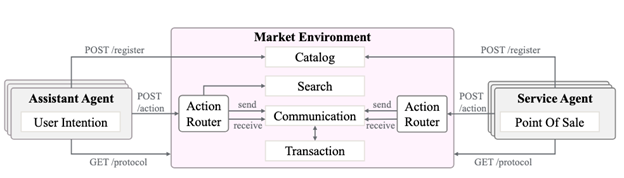
Magentic Marketplace
Magentic Marketplace includes two agent types: Assistant Agents (customers) and Service Agents (businesses). Both interact with a central Market Environment via REST APIs for registration, service discovery, communication, and transaction execution. Action Routers manage message flow and protocol requests, enabling autonomous negotiation and commerce in a two-sided marketplace.. More Info: microsoft.com

Understanding Agent Compatibility

Agent compatibility refers to the ability of agents to interact seamlessly with tools and other agents in a shared space. This compatibility is critical for efficient tool-space interaction, as it enables agents to work together effectively and achieve common goals. In the MCP era, agent compatibility is more important than ever, as it can make or break the success of our systems. To achieve compatibility, developers must focus on designing tools and agents that can work together seamlessly, taking into account factors such as communication protocols and data formats.

Designing for Compatibility at Scale

Designing for compatibility at scale requires a new approach to tool-space design. Rather than focusing on individual tools or agents, developers must take a holistic approach, considering the entire system and how its components interact. This involves:

  • Identifying potential points of interference and designing tools and agents to avoid them
  • Developing standardized communication protocols to enable seamless interaction between agents and tools
  • Creating flexible data formats that can be easily shared and understood by all components of the system

Implementing Agent-Centric Development

To achieve compatibility at scale, developers must adopt an agent-centric approach to development. This involves designing tools and systems around the needs of agents, rather than the other way around. By doing so, developers can create systems that are more efficient, effective, and scalable. The MCP era requires a new way of thinking about tool-space design, one that prioritizes agent compatibility and seamless interaction.

Conclusion

In conclusion, ensuring agent compatibility in the MCP era is crucial for the success of our systems. By understanding the importance of compatibility, designing for compatibility at scale, and adopting an agent-centric approach to development, we can create systems that are more efficient, effective, and scalable. As we move forward in this era, it’s essential to prioritize agent compatibility and work towards creating systems that can support the complex interactions between agents and tools.

Source: Official Link

Stay Ahead in Tech

Join thousands of developers and tech enthusiasts. Get our top stories delivered safely to your inbox every week.

No spam. Unsubscribe at any time.
Related Posts

2025 AI Recap: Top Trends and Bold Predictions for 2026

2025 AI Recap: Top Trends and Bold Predictions for 2026

If 2025 taught us anything about artificial intelligence, it's that the technology has moved decisively from experimentation to execution. This year marked a turning point where AI transitioned from b

read more
Google’s 2025 AI Research Breakthroughs: Gemini 3, Gemma 3 & More

Google’s 2025 AI Research Breakthroughs: Gemini 3, Gemma 3 & More

Key HighlightsThe Big Picture: Google’s 2025 AI research pushes models from tools to true utilities, with Gemini 3 leading the charge. Technical Edge: Gemini 3 Flash delivers Pro‑grade reasoning at

read more
Weekly AI News Roundup: The 5 Biggest Stories (January 1-7, 2026)

Weekly AI News Roundup: The 5 Biggest Stories (January 1-7, 2026)

Happy New Year, everyone! If you thought 2025 was wild for artificial intelligence, the first week of 2026 just looked at the calendar and said, "Hold my beer." We are only seven days into the year, a

read more
Daily AI News Roundup: 09 Jan 2026

Daily AI News Roundup: 09 Jan 2026

Nous Research's NousCoder-14B is an open-source coding model landing right in the Claude Code moment Nous Research, backed by crypto‑venture firm Paradigm, unveiled the open‑source coding model NousCo

read more
Unleashing Local AI Power with Nexa.ai's Hyperlink

Unleashing Local AI Power with Nexa.ai's Hyperlink

Key HighlightsFaster indexing: Hyperlink on NVIDIA RTX AI PCs delivers up to 3x faster indexing Enhanced LLM inference: 2x faster LLM inference for quicker responses to user queries Private and secure

read more
Activation Functions: The 'Secret Sauce' of Deep Learning

Activation Functions: The 'Secret Sauce' of Deep Learning

Have you ever wondered how a neural network learns to understand complex things like language or images? A big part of the answer lies in a component that acts like a tiny decision-maker inside the ne

read more
Light-Based AI Computing: A New Era of Speed and Efficiency

Light-Based AI Computing: A New Era of Speed and Efficiency

Key HighlightsAalto University researchers develop a light-based method for AI tensor operations This approach promises dramatically faster and more energy-efficient AI systems The technique could be

read more
Adobe Firefly Image 5 Revolutionizes AI Image Generation

Adobe Firefly Image 5 Revolutionizes AI Image Generation

As the AI image generation landscape continues to evolve, Adobe is pushing the boundaries with its latest Firefly Image 5 model. This move reflects broader industry trends, where companies like Canva

read more
Adobe's AI Creative Director

Adobe's AI Creative Director

As the lines between human and artificial intelligence continue to blur, companies like Adobe are pushing the boundaries of what's possible with AI-powered creative tools. This move reflects broader i

read more