IterResearch: The AI Research Method That Solves the Context Overload Problem
- Turker Senturk
- AI
- 11 Nov, 2025
- 4 min read
When AI agents dive into complex research tasks, they face a challenge remarkably similar to a detective drowning in case files. Traditional AI research methods pile up information like an endless scroll, eventually collapsing under their own weight. Enter IterResearch—a breakthrough approach that’s rewriting the rules of how AI handles deep research.
The Core Problem: Why Traditional AI Research Hits a Wall
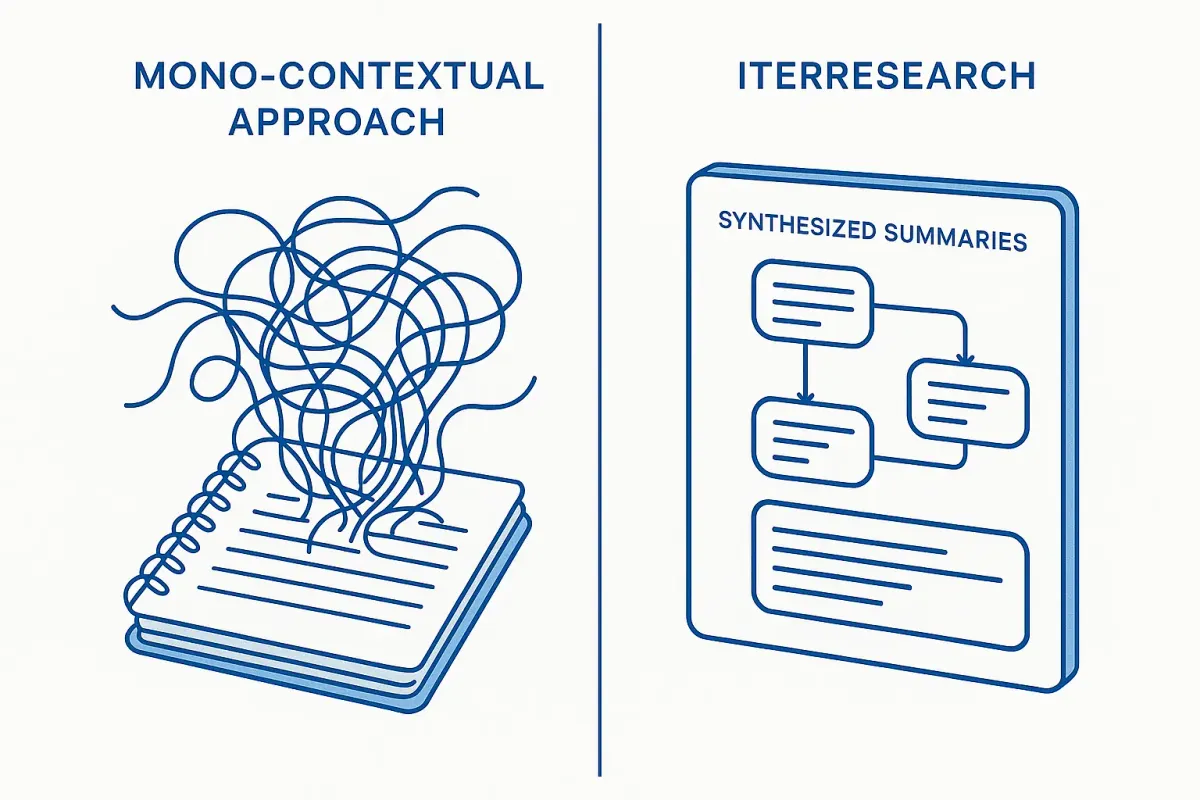
The conventional approach to AI research, known as the mono-contextual paradigm, works like a single, ever-expanding notebook. Every web search result, every piece of data, every thought process gets appended to one continuous context. It’s simple in theory, but catastrophic in practice.
This method suffers from two critical failures:
Context Suffocation: As the AI’s “notebook” fills up with historical data, there’s progressively less room for actual reasoning. The AI essentially runs out of mental workspace, forcing it to make rushed conclusions simply because it’s out of space.
Noise Contamination: Early mistakes and irrelevant information become permanently embedded in the context. These errors create what researchers call “cascading interference”—where initial mistakes actively corrupt later reasoning stages, making it nearly impossible to stay focused on what matters.
IterResearch: The Smart Alternative
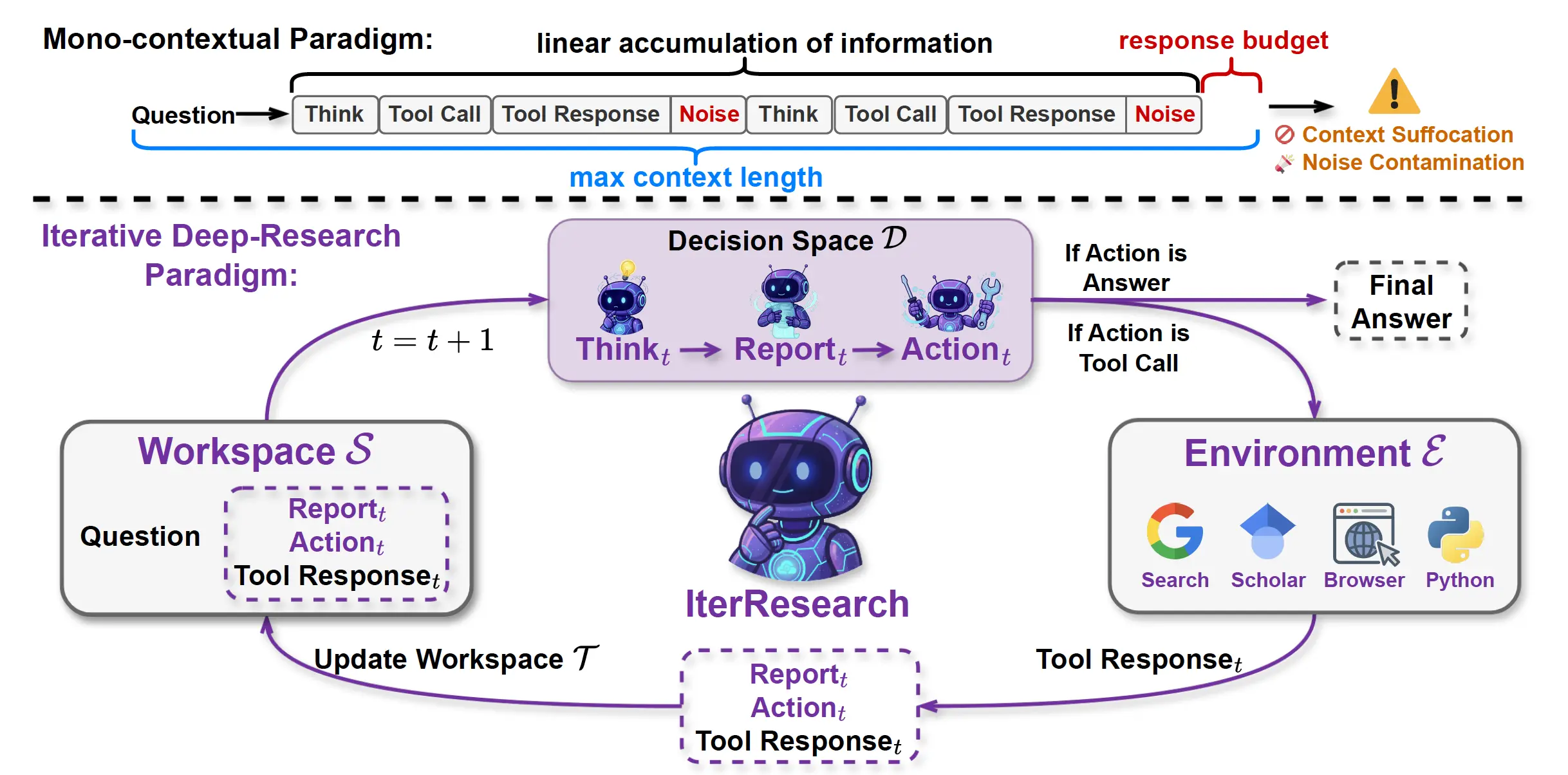
IterResearch transforms AI research through a fundamentally different approach: iterative synthesis. Instead of one messy scroll, imagine a researcher who, after each discovery, writes a clean, updated summary before moving forward.
Two Key Mechanics That Make It Work
1. Strategic Workspace Reconstruction
In each research cycle, IterResearch creates a fresh workspace containing only three essential elements:
- The original research question
- The latest synthesized findings
- The single most recent piece of information
This isn’t just organizational—it’s revolutionary. The AI always operates from a position of clarity, never weighed down by the entire messy history of its investigation.
2. The Evolving Report
Rather than raw data accumulation, IterResearch maintains an intelligent, compressed memory—a synthesized report that filters noise, connects important ideas, and summarizes key findings. This enables both intelligent synthesis and strategic forgetting: the crucial ability to discard what’s irrelevant and focus exclusively on what matters.
The report evolves and improves with every cycle, becoming progressively more accurate and concise.
Head-to-Head Comparison
| Aspect | Traditional (Mono-Contextual) | IterResearch (Iterative) |
|---|---|---|
| Information Handling | Accumulates all information linearly | Periodically synthesizes information |
| Memory Structure | Single, ever-expanding context | Clean, evolving report |
| Error Management | Early mistakes are permanent | Noise filtered during synthesis |
| Long-Task Performance | Degrades as context fills | Maintains consistent reasoning |
| Workspace | Cluttered with historical data | Reconstructed cleanly each cycle |
Real-World Impact: The Numbers Don’t Lie
IterResearch isn’t just theoretically superior—it delivers measurable breakthroughs:
Superior Accuracy: When tested across six challenging research benchmarks, IterResearch outperformed existing open-source AI agents by an average of 14.5 percentage points. This represents a significant leap in reliability and accuracy for complex questions.
Unprecedented Endurance: IterResearch successfully handled tasks with up to 2,048 interactions—a length that’s structurally impossible for traditional mono-contextual agents. On extremely difficult tasks, performance improved dramatically from just 3.5% to 42.5% as the AI was given more time to explore.
Universal Applicability: The core strategy works so well that it can enhance other advanced AI models without additional training. When applied to other powerful AIs, it boosted their performance on long-term research tasks by up to 19.2 percentage points compared to the standard ReAct method.
Why This Matters for the Future of AI
The breakthrough of IterResearch lies in its fundamental shift from accumulation to synthesis. Instead of remembering everything, it focuses on remembering what’s important.
This paradigm opens doors to AI agents capable of tackling truly complex, long-horizon challenges—from scientific discovery to comprehensive market analysis. By cyclically creating clean, synthesized understanding, AI is developing the endurance needed for the world’s most demanding problems.
Traditional methods treated AI memory like an infinite storage device. IterResearch recognizes what human researchers have always known: smart forgetting is just as important as smart remembering.
The Bottom Line
IterResearch represents a fundamental rethinking of how AI handles complex research. By replacing linear accumulation with iterative synthesis, it solves the context overload problem that has plagued AI agents for years.
For anyone working with AI research tools, understanding this paradigm shift isn’t optional—it’s the difference between an AI that drowns in data and one that genuinely thinks through problems.
The future of AI research isn’t about bigger context windows. It’s about smarter synthesis. IterResearch proves that sometimes, the best way to remember more is to strategically forget what doesn’t matter.
Source: Source Article
Tags :
Share :
Stay Ahead in Tech
Join thousands of developers and tech enthusiasts. Get our top stories delivered safely to your inbox every week.
No spam. Unsubscribe at any time.