AgenticSciML: How AI Teams Are Accelerating Scientific Discovery
- Turker Senturk
- AI
- 11 Nov, 2025
- 5 min read
Scientific Machine Learning (SciML) combines data-driven learning methods with traditional physics-based modeling to tackle complex problems in science and engineering. Yet designing effective SciML models remains heavily dependent on expert knowledge—a time-intensive, labor-demanding process that creates a significant bottleneck in scientific progress.
What if we could automate this expertise-driven process? Enter AgenticSciML.
What Is AgenticSciML?
AgenticSciML is a collaborative multi-agent system composed of over 10 specialized AI “agents” working together to discover novel solutions for scientific problems. Think of it as a brainstorming team where each member brings different expertise to the table.
The system’s goal isn’t just to optimize existing solutions—it’s designed to discover completely new and innovative solution strategies that haven’t been thought of before.
Meet the AI Team: Key Roles in AgenticSciML
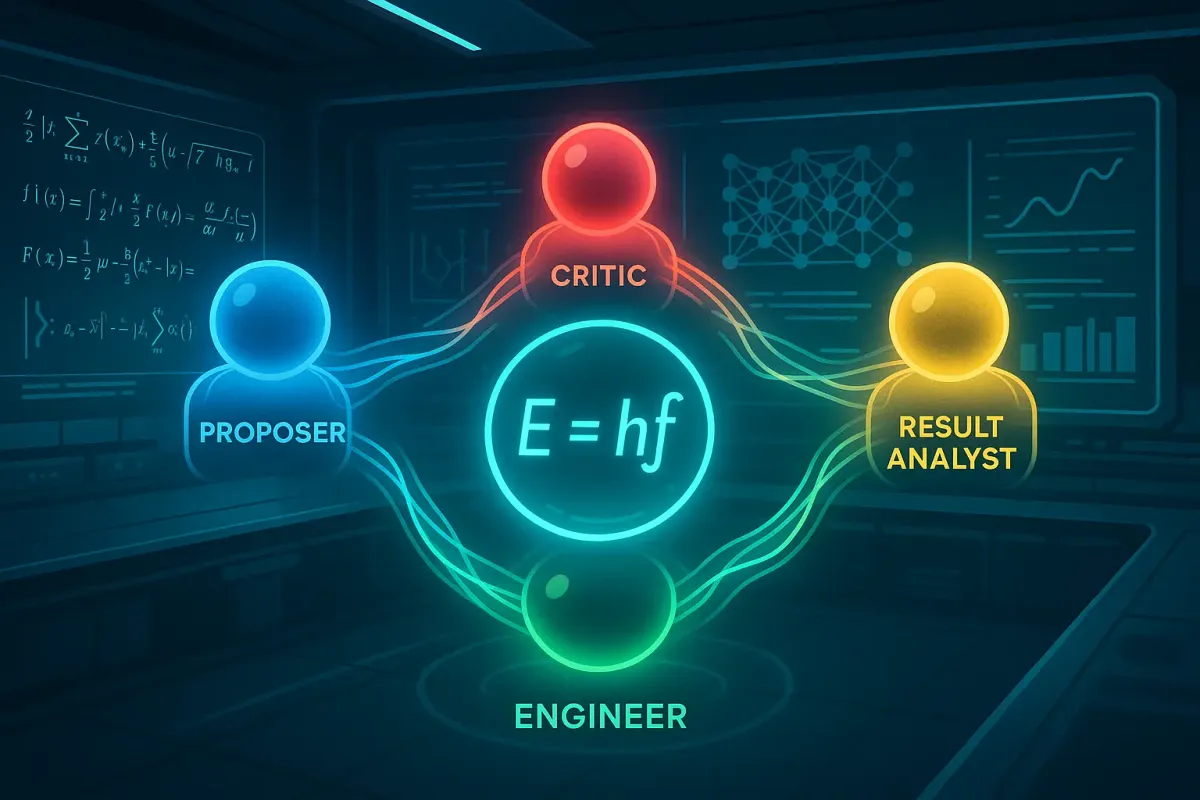
The system’s success depends on four critical roles working in harmony, each playing an essential part from idea generation to final analysis:
| Agent Role | Nickname | Core Responsibility | Why It Matters |
|---|---|---|---|
| Proposer | Creative Thinker | Analyzes current solutions and proposes bold new ideas and strategies for improvement | Drives innovation and generates original solutions |
| Critic | Voice of Reason | Identifies potential weaknesses, logical flaws, and risks in proposed ideas through constructive feedback | Ensures ideas are robust and implementable |
| Engineer | Master Builder | Takes the finalized plan agreed upon by Proposer and Critic and writes or modifies code to implement the solution | Transforms ideas into working solutions |
| Result Analyst | Objective Observer | Analyzes completed solution performance (training logs, test results, graphs) and prepares reports for future improvements | Enables the system to learn from successes and failures |
From Idea to Solution: How AgenticSciML Works
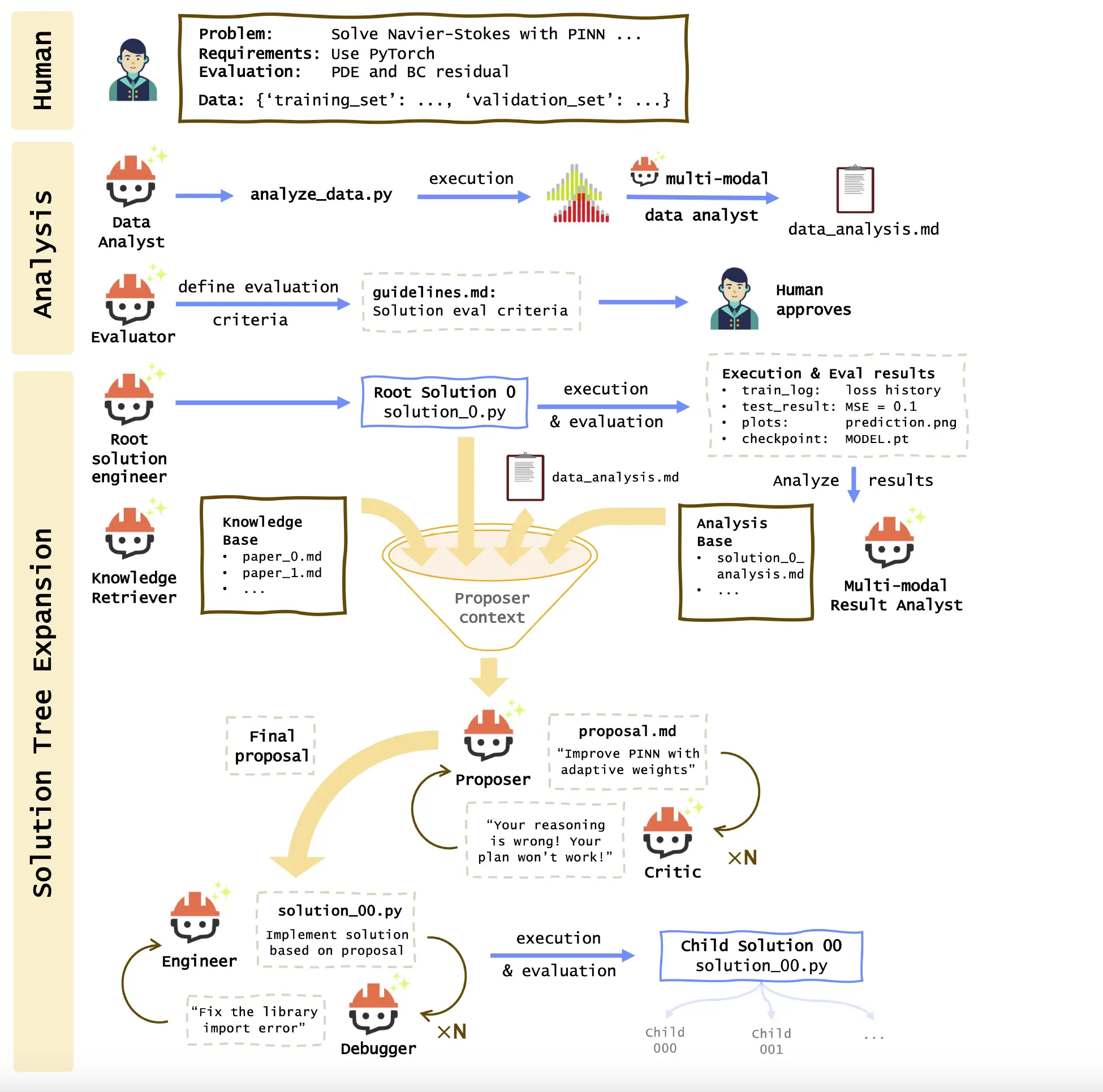
AgenticSciML follows a structured three-phase process to transform ideas into concrete solutions, operating autonomously with minimal human supervision:
Phase 1: Starting Point (Human Input)
The process begins when a human defines the problem to solve, basic requirements, and success criteria. This initial input represents less than 0.3% of the total text generated throughout the entire process, demonstrating the system’s autonomous operation.
Phase 2: Setting the Stage (Analysis and Evaluation)
- A Data Analyst agent analyzes human-provided data to extract key insights and patterns
- An Evaluator agent creates clear rules (an “evaluation contract”) to determine whether a solution counts as “successful”
- The contract is approved by the human, then the process continues
Phase 3: Solution Evolution (Core Loop)
This is where the system’s heart beats. The loop creates an “evolution tree” that continuously produces better solutions—imagine a family tree where each solution branches into improved “child” solutions:
- Initial Solution: A Root Solution Engineer creates a baseline solution (Solution 0) to build upon
- Idea Discussion (Debate Loop): Proposer and Critic agents engage in structured debate about how to improve the current solution. This structured discussion ensures ideas are rigorously tested for logical flaws and feasibility issues before costly coding and testing begins—the key to the system’s efficiency and innovation
- Implementation and Testing: The Engineer agent transforms the debate outcome into code. A Debugger agent fixes any emerging errors
- Analysis and Learning: The new solution is tested and evaluated by a Result Analyst, whose analysis becomes valuable input for the next debate round
- Iteration: The system repeats this “discuss-build-test-learn” cycle until finding the optimal solution
Why It Matters: The Power of Collaboration
AgenticSciML’s success comes not from a single superintelligent AI, but from the collective intelligence formed by agents with different roles. This collaborative intelligence produces results that a single agent or human couldn’t achieve alone.
Massive Performance Gains
Solutions developed by AgenticSciML have demonstrated 10 to 11,000 times better performance compared to baseline solutions designed by a single AI agent or human. This translates to thousands-fold reductions in error rates.
Discovery of Original Strategies
One of the system’s most impressive aspects is its ability to invent completely new SciML strategies not directly present in its knowledge base. For example, it has developed innovative approaches like “adaptive mixture-of-expert architectures” and “decomposition-based PINNs” (Physics-Informed Neural Networks).
Automation of Complex Processes
The system fully automates model design and testing processes that would normally take scientists weeks or months, allowing scientific discoveries to progress at unprecedented speed.
The Bottom Line
AgenticSciML proves that a team of specialized AI agents can achieve superhuman performance on complex scientific problems through collaboration and structured debate, while producing completely novel solutions. This approach goes beyond being merely an automation tool that speeds up existing processes—it’s a revolutionary step toward autonomous discovery in scientific computing.
As AI continues to evolve, systems like AgenticSciML point toward a future where machines don’t just assist human researchers, but actively participate in pushing the boundaries of scientific knowledge.
Note: Specific details about the AgenticSciML system, including performance metrics and architectural specifics, could not be verified against published sources. The concepts discussed align with current research in multi-agent systems and scientific machine learning, as evidenced by:
- AgenticIML - Main Article
- Multi-Agent Reinforcement Learning Review - Applied Sciences Journal
- ML-Agent: Reinforcement Learning for Autonomous ML - arXiv
- Agentic AI Survey - ScienceDirect
- SciML Agents Research - arXiv
For the most accurate information about any specific AgenticSciML implementation, please refer to the original source material.
Tags :
Share :
Stay Ahead in Tech
Join thousands of developers and tech enthusiasts. Get our top stories delivered safely to your inbox every week.
No spam. Unsubscribe at any time.