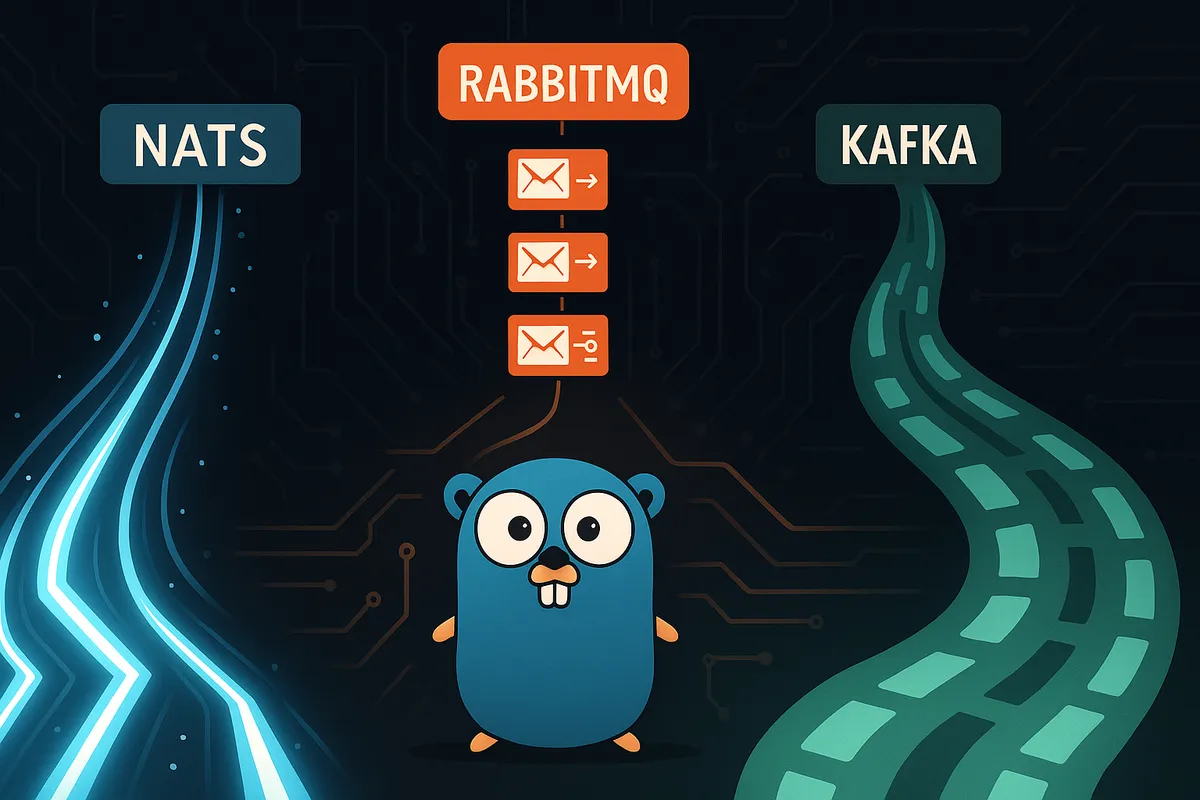
NATS vs RabbitMQ vs Kafka: Choosing the Right Message Broker for Go
- Turker Senturk
- Software
- 14 Nov, 2025
- 6 min read
Building event-driven systems in Go? Choosing the right message broker can make or break your architecture. While Go gives you powerful concurrency tools like goroutines and channels, scaling beyond a single application requires a robust messaging system. Let’s dive into three popular choices—NATS, RabbitMQ, and Apache Kafka—and help you pick the right one for your project.
Why Event-Driven Architecture Matters
Event-Driven Architecture (EDA) allows services to communicate asynchronously through events rather than direct API calls. This approach brings serious benefits:
- Loose Coupling: Services don’t need to know about each other—they just publish and subscribe to events
- Better Scalability: Scale individual services based on their load, not the entire system
- Improved Resilience: If one service fails, others keep running; the broker holds messages until recovery
- Easy Evolution: Add new features by creating new event consumers without touching existing code
Go’s lightweight goroutines and channels make it perfect for handling thousands of concurrent event streams with minimal overhead. But to connect services across machines, you need a message broker.
NATS: The Speed Demon
NATS is built for one thing: raw speed. If you need the fastest possible message delivery and don’t require complex features, NATS is your answer. It’s incredibly lightweight and uses a simple publish-subscribe model that makes it easy to understand and deploy.
Key Features
- Blazing Fast Performance: Sub-millisecond latency for message delivery
- Simple Deployment: Single binary, minimal configuration, built-in clustering
- Subject-Based Routing: Use wildcard patterns for flexible message routing
- Low Resource Usage: Minimal memory and CPU footprint
Strengths and Weaknesses
| Strengths | Weaknesses |
|---|---|
| Extremely fast message delivery | Limited persistence options by default |
| Super lightweight and simple | No built-in message ordering guarantees |
| Easy clustering and high availability | Fewer advanced routing features compared to RabbitMQ |
| Native Go client with excellent performance | Not ideal as a durable event store |
Best For
- Real-time messaging systems (chat, notifications, live updates)
- High-throughput microservices communication
- IoT applications with thousands of devices
- Systems where speed trumps message durability
RabbitMQ: The Swiss Army Knife
RabbitMQ is the mature, feature-rich choice that handles complex routing scenarios with ease. Built on the AMQP protocol, it’s designed for reliability and provides enterprise-grade message handling capabilities.
Key Features
- Flexible Routing: Topic, direct, fanout, and header-based routing options
- Message Persistence: Durable queues and persistent messages survive broker restarts
- Dead Letter Queues: Automatic handling of failed messages
- Priority Queues: Process important messages first
- Rich Plugin Ecosystem: Extend functionality with official and community plugins
Strengths and Weaknesses
| Strengths | Weaknesses |
|---|---|
| Feature-rich with powerful routing | More complex setup and configuration |
| Excellent durability and persistence | Higher resource usage than NATS |
| Strong community and ecosystem | Steeper learning curve |
| Great tooling and management UI | Can become a bottleneck under extreme load |
Best For
- Enterprise applications requiring guaranteed delivery
- Complex workflow orchestration
- Task queue systems with retry logic
- Applications where losing a message is unacceptable
Apache Kafka: The Distributed Log
Kafka isn’t a traditional message queue—it’s a distributed commit log. This fundamental difference makes it incredibly powerful for handling massive data streams but adds operational complexity.
Key Features
- Distributed Log Architecture: Messages stored as an ordered, immutable log
- Partitioning: Horizontal scaling through topic partitions
- Message Replay: Consumers can re-read messages from any point in time
- High Throughput: Handles millions of messages per second
- Consumer Groups: Built-in load balancing and failover for consumers
Strengths and Weaknesses
| Strengths | Weaknesses |
|---|---|
| Massive scalability and throughput | High operational complexity |
| Durable, persistent event storage | Requires ZooKeeper (or KRaft) management |
| Message replay capability | Steeper learning curve than alternatives |
| Perfect for event sourcing | Overkill for simple messaging needs |
Best For
- Large-scale data streaming pipelines
- Event sourcing architectures
- Real-time analytics platforms
- Systems requiring complete audit trails and message replay
Side-by-Side Comparison
Here’s how these three stack up across key dimensions:
| Feature | NATS | RabbitMQ | Apache Kafka |
|---|---|---|---|
| Primary Use Case | Fast pub/sub messaging | Reliable message queuing | Distributed event streaming |
| Performance | Fastest (sub-ms latency) | Good (ms latency) | High throughput (batch-oriented) |
| Persistence | Limited by default | Strong with durable queues | Highly durable commit log |
| Routing | Simple subject-based | Complex, feature-rich | Topic and partition-based |
| Message Replay | No | No | Yes |
| Ordering Guarantees | No | Per-queue | Per-partition |
| Operational Complexity | Very low | Medium | High |
| Go Client Maturity | Excellent | Excellent | Good |
Which One Should You Choose?
Choose NATS When
- You need the absolute fastest message delivery
- Your microservices require real-time communication
- Simplicity and ease of deployment are priorities
- Message persistence isn’t a critical requirement
- You’re building IoT systems with high-volume sensor data
Choose RabbitMQ When
- You need guaranteed message delivery
- Your workflows require complex routing logic
- Dead letter queues and retry mechanisms are important
- You’re integrating diverse enterprise systems
- Task queuing with durability is your primary use case
Choose Kafka When
- You’re processing massive data streams (millions of events/second)
- You need to replay messages or build event-sourced systems
- Real-time analytics and data pipelines are core requirements
- You have the operational expertise to manage a distributed system
- You’re building a platform where events are the source of truth
Practical Considerations for Go Developers
When working with these systems in Go, consider:
NATS offers the most idiomatic Go experience with excellent client libraries that feel native to the language. You’ll spend minimal time on infrastructure and more time building features.
RabbitMQ requires understanding AMQP concepts but provides robust Go clients. Be prepared to handle connection management and learn its routing patterns—it’s worth the investment for complex systems.
Kafka demands significant learning but offers powerful stream processing capabilities. The Go clients are solid, though you’ll need to understand partitions, consumer groups, and offset management.
The Bottom Line
There’s no universal “best” message broker—only the right tool for your specific needs:
- NATS wins on speed and simplicity
- RabbitMQ excels at reliability and complex routing
- Kafka dominates in scalability and data streaming
Start with your requirements: Do you need raw speed? Choose NATS. Complex workflows with guaranteed delivery? RabbitMQ is your friend. Building a data platform? Kafka is the industry standard.
The beauty of Go’s ecosystem is that switching between these systems is relatively straightforward if your needs evolve. Focus on building clean abstractions around your messaging layer, and you’ll maintain flexibility as your architecture grows.
Remember: The best architecture is one that solves your actual problems, not the one with the most features. Start simple, measure your needs, and scale when necessary.
Share :
Stay Ahead in Tech
Join thousands of developers and tech enthusiasts. Get our top stories delivered safely to your inbox every week.
No spam. Unsubscribe at any time.